
Clinical Nurse Specialist Lizzie Kenedler has completed a Research Fellowship project with ARC East of England on the experiences of women with first episode psychosis at midlife in menopause, who can have longer periods of illness and psychosis symptoms which are harder to treat.
Lizzie explains more about her research in this blog.
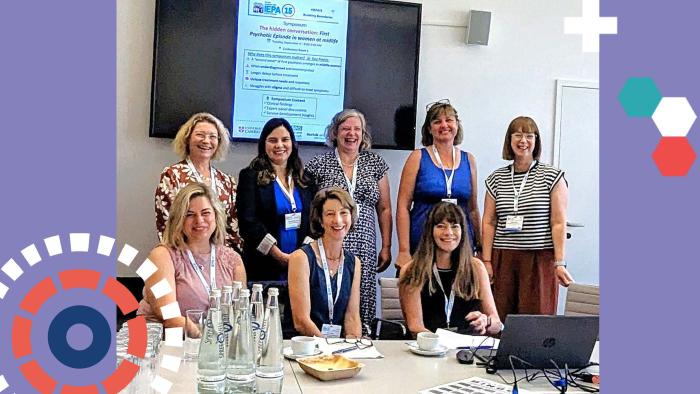
Lizzie is working with NHS early intervention services at Cambridgeshire and Peterborough NHS Foundation Trust (CPFT) to explore how to provide the best care for these women and recently delivered an international symposium with her NHS colleagues, pictured above (third, back row).
I have worked in clinical practice in CPFT’s CAMEO (Cambridgeshire and Peterborough Assessing, Managing and Enhancing Outcomes) early intervention service for 20 years. We provide a mental health service for people who are experiencing their first episode of psychosis and research is embedded within our clinical practice at CAMEO. We develop and deliver evidence-based practice to provide the best possible care and treatment.
My research focuses on exploring women’s presentation of first episode psychosis to our service at midlife aged between 40 and 60. It is well documented that women are particularly vulnerable to developing psychotic experiences at midlife but there is limited research and no formal clinical guidelines in this area. Much early intervention research has focused on younger cohorts, and we wanted to match this for women with different presentations, specific needs and responsibilities in their lives.
I wanted to understand their clinical presentations, care and treatment received and how well services understand the role of the menopause within this. The aim of my Research Fellowship project was to support best evidence-based clinical practice for these women to safeguard their recovery and personalise their care and treatment.
"The ARC Fellowship programme has helped me gain the skills to undertake this study and ensured it has the best possible impact on clinical practice. The Fellowship gave me dedicated time to review current literature and complete this service evaluation, which had been impossible to do within the demands of a clinical role."
Lizzie Kenedler, ARC East of England Fellow and CPFT Clinical Nurse Specialist
I looked at 44 case note reviews from over a three-year period (2016-2019) and applied the PANSS assessment tool which rates the severity of positive and negative symptoms of psychosis and devised some data points as benchmarks from my literature review. I applied the same notes review to our younger population under 35 years of age for comparison.
Our results show that psychotic experiences for women at midlife can be driven by anxiety and depression which resulted in suspicious and paranoid delusions. Menopausal age correlates with increased development of both somatic and psychological health problems in women. The presence of suspicious and persecutory thoughts marked by distrustfulness cause major disruption to interpersonal relations and may impact women’s ability to engage with services for support. The impact of depressive symptoms characterised by social exclusion, isolation and negative thoughts will also have an impact on engagement with mental health services.
Women in midlife are at higher risk of depression partly due to the natural hormonal alterations of perimenopause and menopause. In addition to hormonal changes, midlife can be a time marked with greater losses, like empty-nest syndrome, ailing or deceased parents and bereavements, career changes, and a loss of former friendships, marital and love partnerships. Women in midlife also have reported higher rates of pain and physical ailments.
"We need to take stock, promote women’s mental health, appropriate service options and ensure that women are asked the right questions when they present or self-refer to services. Response to anti-psychotic treatment appears to be worse for these women due to hormonal changes and effect on dopamine, requiring higher doses which means greater risk of side effects and impact on physical health needs."
I work with brilliant clinical colleagues at CPFT who have built CAMEO’s expertise and reputation over many years as a centre of mental health excellence, and I’ve witnessed the impact this has on delivering the best care, igniting the curiosity of our practitioners, and the confidence people feel in our care. The CAMEO team were invited to present a symposium on mid-life psychosis at the IEPA conference in Berlin this year (September 2025) and we were delighted to share the findings from all of our projects and best practice with lived experience experts at this event.
Delivering this symposium to an international audience was a great opportunity to share and learn from others and further develop plans for research projects. Our lived-experience project team members have provided invaluable insight and support through co-production, and presenting part of the symposium from their perspective builds their experience and learning.
"We now have a better understanding of clinical presentation and treatment of women with first episode psychosis at mid-life which will help us enhance care and support to improve outcomes."
Next steps
CPFT is one of three early intervention in psychosis teams in Cambridgeshire, Suffolk and Norfolk working on projects to explore service user experiences, clinical presentation, needs and suitable treatments for mid-life psychosis. We are co-producing the Menopause Journey in First Episode Psychosis Screening Tool (MJ-FEP) to pilot in NHS services. This is a clinical questionnaire covering self-reported symptoms of menopause and other conditions linked to the onset of psychosis at mid-life. We hope this tool will give a voice to our client group to express their needs so we can offer them more personalised care. If you would like to know more or get involved in our work to improve care for these women, please get in touch! Lizzie.Kenedler@cpft.nhs.uk
- Watch Lizzie’s talk sharing her Fellowship experience and project outcomes
(click below to play from 18.17)