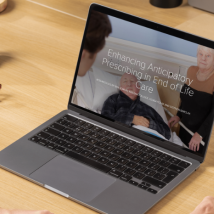
As end-of-life care increasingly shifts into community and home settings, understanding family perspectives is vital. ARC East of England researcher Dr Ben Bowers is addressing this need through research and a creative collaboration with public contributor Bella Madden, who crafted a poem that gives voice to families’ experiences. In this blog, they share their creative approach and joint paper.
- Click below to play the video of Bella reading her poem ‘Sorted’
‘Sorted’ is Bella’s response to reading research interview transcripts with family caregivers, patients and clinical staff involved in using injectable end-of-life symptom management medicines. These are a pack of medicines that are routinely prescribed for dying people in the United Kingdom and left in the home ‘just in case’ of emergencies. The pack often contains powerful medicines, including morphine for pain and midazolam as a sedative for distress. The poem gives a powerful insight into people’s worries, fears and how they cope with end-of-life care as well as the relief and reassurance that healthcare staff can provide at this time.
This work is part of a four-year interdisciplinary research project seeking to understand the human and system factors involved in the safe, effective and timely use of injectable end-of-life symptom control medications for adults dying at home. The project is led by Ben Bowers at ARC East of England and funded by his Wellcome Trust Early Career Award.
Bella Madden, Public Contributor
I first became involved in end-of-life care research when I answered an email asking for public contributors from the Palliative and End of Life Care Group in Cambridge (PELiCam) working with researchers including Ben Bowers (Deputy Theme Lead for Palliative and End of Life Care). My first partner had died from bowel cancer and I had been his carer at home for the two years prior to his death in our local hospice.
Ben was aware that I wrote a good deal of poetry, as I had used my own writing in presentations to medical students about the role of the family caregiver in cases of terminal illness. However, when he first asked me, I was both delighted and mystified as I struggled to really understand why this would be of benefit to his research, until Ben explained that the aim was to approach this creatively in a radically different way. He wanted to give me the creative and emotional space to respond to research participants shared accounts through poetry form.
I also struggled to find structure for the poem for a long time until I simply stopped thinking about it and started writing - with no idea where I was going with it. This is a strategy I have used when running poetry workshops in the past where the focus is less the literary form of the poem itself, and more the expression of core feelings and experiences. It is basically a way to ‘stop thinking and write moment to moment whatever comes to you then see what your words tell you’. This approach lets the big stuff emerge and what happened here I think, is that the feeling of being a carer expressed itself in the words and form of the poem without a conscious decision to make that happen.
The poem distills the experiences and perspectives of seven participants representing patients, family caregivers and community nurses. In addition, of course, my own experience informed the piece even if on a subconscious level.
"The interview transcripts demonstrate the power of care that recognises, knows and validates the worries and needs of the individuals within a large complex system of care. That recognition in itself is healing."
Bella Madden, Public Contributor
These approaches bypass the analytical and go straight for the feeling. The analysis is still in there, but we do not experience life in thematic threads. These approaches remind us of that and can both restore the bigger picture and the individual human experience that are necessarily subsumed as qualitative data is analysed and presented. They bring the research home by turning academic discourse into a more accessible, conversational one.
That more everyday, conversational tone helps people feel seen and heard. There is a loneliness and isolation involved with the end of life and family caregiving during this time. That much is expressed in ‘Sorted’ and so I hope that this poem helps to remind healthcare staff of their important role in alleviating that isolation. It celebrates that human connection between patient, family caregiver and healthcare worker.
ARC East of England has supported this work through the Palliative and End of Life Care theme, providing seed funding and facilitating wider communication of the research and my role as public contributor in it. This has included championing our work and providing opportunities to present both the process of collaboration and the resulting poem at regional level.
"I have always felt valued and respected as a public contributor. This experience has enhanced that feeling even further. I feel that my contribution counts. It matters. I am not there to tick a box - I am being asked to actively and creatively engage with the research process, and as I do so, I am learning to have greater confidence in my voice and experience. I am making a difference.”
Bella Madden, Public Contributor
For very good reasons, research processes are beset by ethical considerations but there is a risk that in efforts to protect participants’ feelings, research fails to release the experience it seeks to investigate. I can recall conversations with researchers who have been emboldened by public contributors’ input to interview people dying, where they have previously felt this might be too fraught with ethical dilemmas. Addressing inequality of voice requires trusting the person whose voice you release to cope with the consequences of expression. The fact that they are in front of you is testament to the fact that they are already coping and want to share their story.
"The most powerful thing research can do is to have the courage to open up space for open conversations around death and dying. I feel this from both my own experience and from conversations I have had with others who have cared for loved ones at the end of life."
Bella Madden, Public Contributor
- Read the full article about the poem and this interpretive approach to research in the Journal of Research in Nursing
Get involved in future research
If you have lived experience of palliative and end-of-life care and would like to be part of future research projects, contact Ben Bowers by emailing
bb527@medschl.cam.ac.uk. Ben is Assistant Professor of Primary Care at the University of Cambridge Primary Care Unit and ARC East of England Deputy Theme Lead for Palliative and End of Life Care.
ARC East of England runs a range of events and schemes for aspiring researchers, including the ARC Research and Impact Fellowships programme which runs every year. It is recommended to explore these competitive opportunities in advance to prepare an application and reach out to researchers within your field of interest for advice on the next best steps.